🚀 Expedition 33 – A Complete Mission Overview
Expedition 33 was a crucial mission to the International Space Station (ISS) carried out by NASA in collaboration with international partners. This space mission marked a period of important scientific research, long-duration crew operations, and remarkable milestones aboard the ISS. From its launch to its safe return to Earth, Expedition 33 demonstrated human capability for sustained spaceflight, cutting-edge experiments, and international teamwork.
Originally launched in late 2012 and extending into early 2013, Expedition 33 played a significant role in developing scientific knowledge and operational experience that continue to benefit future space exploration.
🧑🚀 Crew Members of Expedition 33
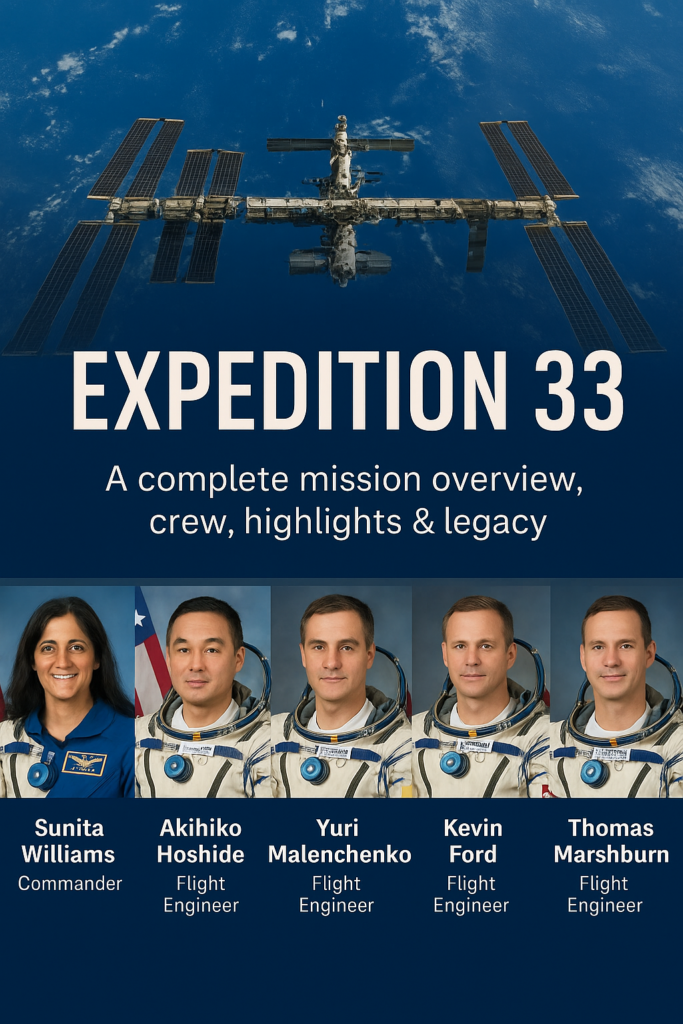
Expedition 33 featured a diverse team of astronauts and cosmonauts from various countries, bringing together expertise and skill sets critical to long-duration space missions. The crew included:
- Sunita Williams (NASA) – Commander of Expedition 33
- Akihiko Hoshide (JAXA) – Flight Engineer
- Yuri Malenchenko (Roscosmos) – Flight Engineer
- Kevin Ford (NASA) – Flight Engineer
- Evgeny Tarelkin (Roscosmos) – Flight Engineer
- Thomas Marshburn (NASA) – Flight Engineer
Each member had specific scientific and operational responsibilities including science experiments, maintenance tasks, and spacewalk preparations. Notably, Sunita Williams became one of the few female ISS commanders, representing NASA’s ongoing commitment to global space exploration leadership.
📅 Launch and Return Dates
Expedition 33 officially began when the previous crew departed the ISS and the new team took command in October 2012. The mission extended into March 2013 when the crew members returned safely to Earth.
Mission timeline highlights:
- Launch Window: September to October 2012
- ISS Arrival: October 2012
- Mission Completion: March 2013
- Duration: Approx. 4–5 months aboard the ISS
These long-duration missions help scientists understand how the human body reacts to extended spaceflight — knowledge that is essential for future missions to Mars and beyond.
🔬 Scientific Research and Experiments
One of the primary purposes of Expedition 33 was to continue critical scientific experiments that cannot be performed on Earth. The crew conducted research across a range of fields including biology, human physiology, physics, and materials science.
Key Research Areas:
- Human Life Sciences: Studies on how extended weightlessness affects muscles, bones, and cellular structures.
- Plants and Growth in Space: Experiments to understand plant growth in microgravity — vital for future space agriculture.
- Fluid Physics: Research designed to help spacecraft fuel systems and industrial processes on Earth.
- Technology Demonstrations: Testing new tools and operational systems for life support and station maintenance.
These experiments helped scientists gain insight into human health in space as well as potential applications for Earth-based industries.
🧪 Spacewalks (EVAs)
Although Expedition 33 did not include many large-scale spacewalks compared to some other ISS missions, the crew was involved in detailed preparations and support for EVAs. Spacewalks are essential for station maintenance, hardware upgrades, and installing external experiment modules.
Each spacewalk required extensive coordination between astronauts aboard the ISS and mission control teams on Earth.
🛰️ Operational Achievements
During Expedition 33, the crew managed several important station functions:
- Continuous life support system operations
- Docking and undocking procedures for resupply vehicles
- Robotic arm operations for cargo and scientific tasks
- Communication coordination with Earth-based mission control
These operational achievements reflected ongoing ISS functionality, allowing scientific research to continue without interruption.
🌎 International Collaboration
Expedition 33 demonstrated the strong partnership between space agencies including NASA (USA), Roscosmos (Russia), and JAXA (Japan). The mission reaffirmed the ISS as a symbol of peaceful scientific cooperation.
Each agency contributed personnel, mission planning, and scientific expertise — emphasizing how global teamwork accelerates human knowledge and space capability.
💡 Challenges Faced During Expedition 33
Expedition 33, like all long-duration ISS missions, faced logistical and operational challenges such as:
- Maintaining physical and mental health in confined environments
- Managing limited resources like water and power
- Ensuring experiment integrity under microgravity
Despite these challenges, the crew excelled in teamwork and mission execution.
📊 Legacy and Impact
Expedition 33 contributed to a legacy of continuous human presence in space. Its scientific findings and operational experiences continue to shape:
- Future missions to the Moon and Mars
- Improvements in space habitat designs
- Earth-based applications in medicine, materials science, and biology
Data from this mission also helped refine space travel policies and training protocols for future astronauts.
🧭 Interesting Facts About Expedition 33
Here are some fascinating facts:
✔ Commander Sunita Williams logged hundreds of spaceflight hours and supported multiple experiments.
✔ Multi-national crew highlighted international cooperation.
✔ Research from Expedition 33 is used in current ISS missions.
✔ The ISS remains one of the most complex human-made structures in orbit.
🏁 Mission Summary
| Aspect | Details |
|---|---|
| Mission Name | Expedition 33 |
| Duration | ~4–5 Months |
| Launch | 2012 |
| Return | 2013 |
| Commander | Sunita Williams |
| Partners | NASA, Roscosmos, JAXA |
| Research Focus | Life sciences, fluid physics, plant growth, technology demos |
✨ Conclusion
Expedition 33 stands as a testament to human endurance, international collaboration, and scientific achievement in space. From groundbreaking experiments to efficient ISS operations, this mission enriched our understanding of life beyond Earth.
As space agencies prepare for future lunar and Martian missions, lessons from Expedition 33 will continue to guide explorers and researchers alike.