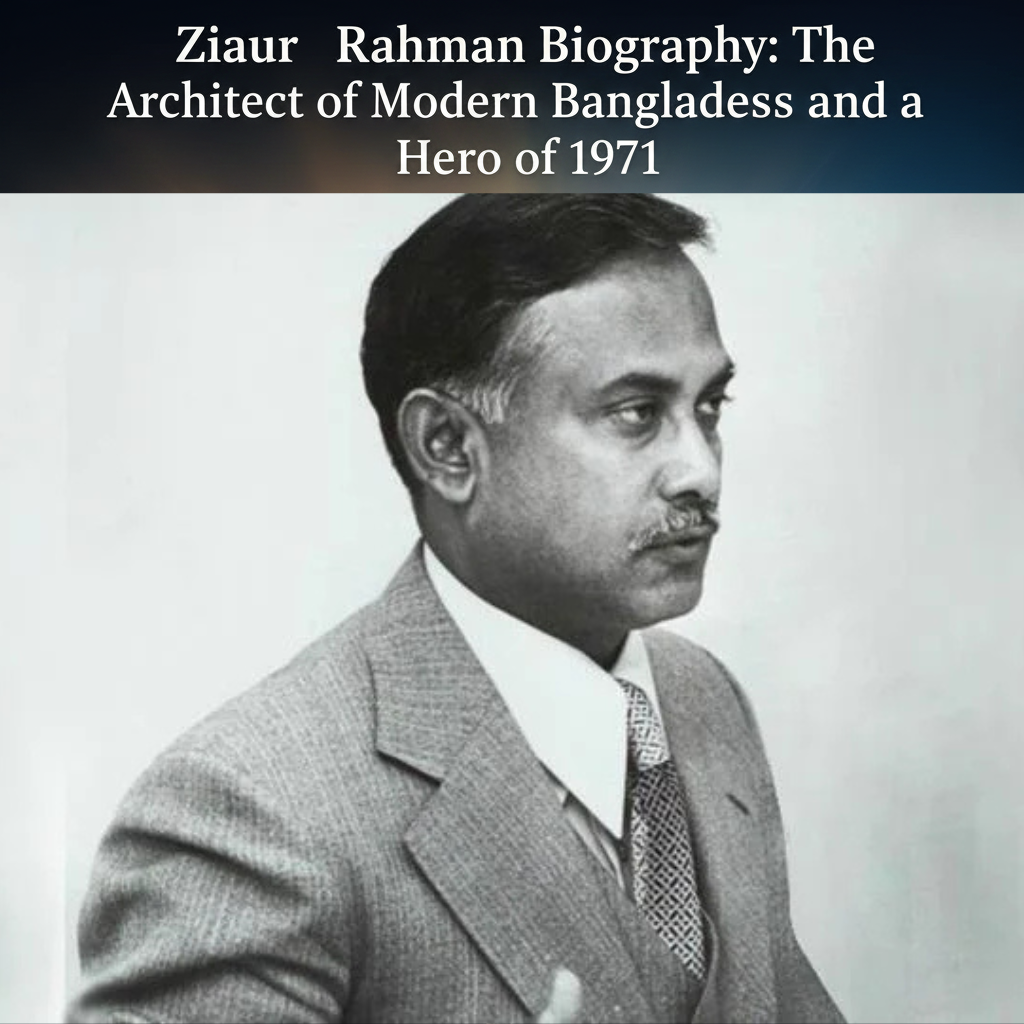
Ziaur Rahman Biography: The Architect of Modern Bangladesh and a Hero of 1971
Ziaur Rahman, popularly known as Zia, stands as one of the most significant and polarizing figures in the history of Bangladesh. A decorated military officer, a fearless freedom fighter, and the seventh President of Bangladesh, his life’s work reshaped the nation’s political, economic, and social landscape. From his historic radio announcement in 1971 to his tragic assassination in 1981, Ziaur Rahman’s legacy continues to influence the identity of Bangladesh.
Early Life and Military Beginnings-Ziaur Rahman Biography
Ziaur Rahman was born on January 19, 1936, in the village of Bagbari in Bogra. His father, Mansur Rahman, was a chemist, and his mother was Jahanara Khatun. Zia spent much of his childhood in Kolkata before moving to Karachi following the partition of India in 1947.
He joined the Pakistan Military Academy in 1953 and was commissioned as a second lieutenant in 1955. Zia was a brilliant soldier, serving in the 1st Punjab Regiment and later in the East Bengal Regiment. During the 1965 Indo-Pakistani War, he commanded a company and was awarded for his bravery. Little did he know that his military training would soon be used to lead a revolution for his own people.
The Historic Declaration of Independence (1971)
The most iconic moment in the Ziaur Rahman biography occurred on March 27, 1971. Following the brutal crackdown by the Pakistan Army (Operation Searchlight), Ziaur Rahman, then a Major, revolted against his superiors.
From the Kalurghat Radio Station in Chittagong, Zia made a historic broadcast. On behalf of the great leader Sheikh Mujibur Rahman, he declared the independence of Bangladesh. This announcement acted as a catalyst, providing a sense of direction and hope to millions of terrified Bengalis and formalizing the resistance movement.
Know More About Ziaur Rahman Biography Click Here
Z-Force and the Liberation War-Ziaur Rahman Biography
During the nine-month-long Liberation War, Ziaur Rahman commanded the Z-Force, the first military brigade of the Bangladesh Forces. His tactical genius and leadership on the front lines earned him the Bir Uttam, the second-highest gallantry award in Bangladesh.
Transition to Power: From Soldier to President
After the independence of Bangladesh, the nation went through a period of extreme political instability. Following the tragic assassination of Sheikh Mujibur Rahman in 1975 and a series of military coups, Ziaur Rahman emerged as a central figure.
-He initially served as the Chief of Army Staff and later as the Chief Martial Law Administrator. In 1977, Ziaur Rahman assumed the office of the President of Bangladesh. Unlike many military rulers, Zia sought to legitimize his power through civilian participation and democratic processes.
Know More about other politician details click here
The Founding of the Bangladesh Nationalist Party (BNP)
Ziaur Rahman realized that for a nation to thrive, it needed a political platform that united diverse ideologies under the umbrella of “Bangladeshi Nationalism.” In 1978, he founded the Bangladesh Nationalist Party (BNP).
The Core Pillars of BNP:
- Bangladeshi Nationalism: Shifting from linguistic identity to a territorial and sovereign identity.
- Democracy: Moving the country back toward a multi-party system.
- Social Justice: Bridging the gap between the urban elite and the rural poor.
- Economic Freedom: Encouraging private enterprise and reducing state control.
Presidential Achievements and Nation Building
Ziaur Rahman’s presidency was marked by a relentless drive for development. He was known for his “canal-digging” programs and his habit of visiting the most remote villages of the country to understand the needs of the people.
1. The Green Revolution and Canal Digging
Zia launched a massive self-reliance movement. He encouraged the masses to dig canals to improve irrigation for agriculture. This significantly boosted food production, moving Bangladesh away from its image as a “bottomless basket.”
2. Foreign Policy and SAARC-Ziaur Rahman Biography
One of Ziaur Rahman’s greatest diplomatic achievements was the conceptualization of SAARC (South Asian Association for Regional Cooperation). He envisioned a platform where South Asian nations could cooperate on trade, security, and development, a vision that became a reality after his death.
3. The Multi-Party Democracy-Ziaur Rahman Biography
Ziaur Rahman is credited with restoring the multi-party democratic system in Bangladesh, which had been replaced by a single-party system (BAKSAL) in early 1975. He released political prisoners and allowed various political ideologies to flourish again.
Economic Reforms and Industrialization
Ziaur Rahman was a proponent of a mixed economy. He began the process of denationalizing industries that had been seized after independence. By encouraging private investment and establishing Export Processing Zones (EPZs), he laid the groundwork for the modern industrial success of Bangladesh, particularly in the garment sector.
The Tragic Assassination (May 30, 1981)
Despite his popularity and developmental success, Ziaur Rahman faced numerous coup attempts during his tenure. On the night of May 30, 1981, during an official visit to Chittagong, he was assassinated by a group of army officers at the Chittagong Circuit House.
His death sent the nation into deep mourning. Millions of people gathered at his funeral at the Parliament (Jatiya Sangsad) area, where he was eventually buried at Zia Udyan (Chandrima Uddan).
The Legacy of Ziaur Rahman-Ziaur Rahman Biography
Ziaur Rahman remains a hero to millions and a controversial figure to others. However, his contributions to the sovereignty and development of Bangladesh are undeniable.
- The Hero of 1971: He provided the military leadership when the nation needed it most.
- The Reformer: He shifted the economy toward a market-driven model.
- The Identity Creator: He introduced the concept of “Bangladeshi Nationalism,” which defined a new era of politics.
Frequently Asked Questions (FAQs)-Ziaur Rahman Biography
1. Who declared the independence of Bangladesh on the radio? Major Ziaur Rahman made the historic declaration of independence on March 27, 1971, from Kalurghat Radio Station on behalf of Sheikh Mujibur Rahman.
2. When did Ziaur Rahman found the BNP? Ziaur Rahman founded the Bangladesh Nationalist Party (BNP) on September 1, 1978.
3. What is Ziaur Rahman’s gallantry award? He was awarded the Bir Uttam for his extraordinary bravery and leadership during the 1971 Liberation War.
4. Where is Ziaur Rahman buried? He is buried in Chandrima Uddan (also known as Zia Udyan) in Dhaka, near the National Parliament building.
5. What was Ziaur Rahman’s contribution to regional diplomacy? He was the primary visionary behind the formation of SAARC, aiming for regional cooperation in South Asia.
Ziaur Rahman Biography
We know the war he leads for bangladesh .